Conduit Urbanism: Great Lakes Megaregion
Great Lakes Megaregion, North America

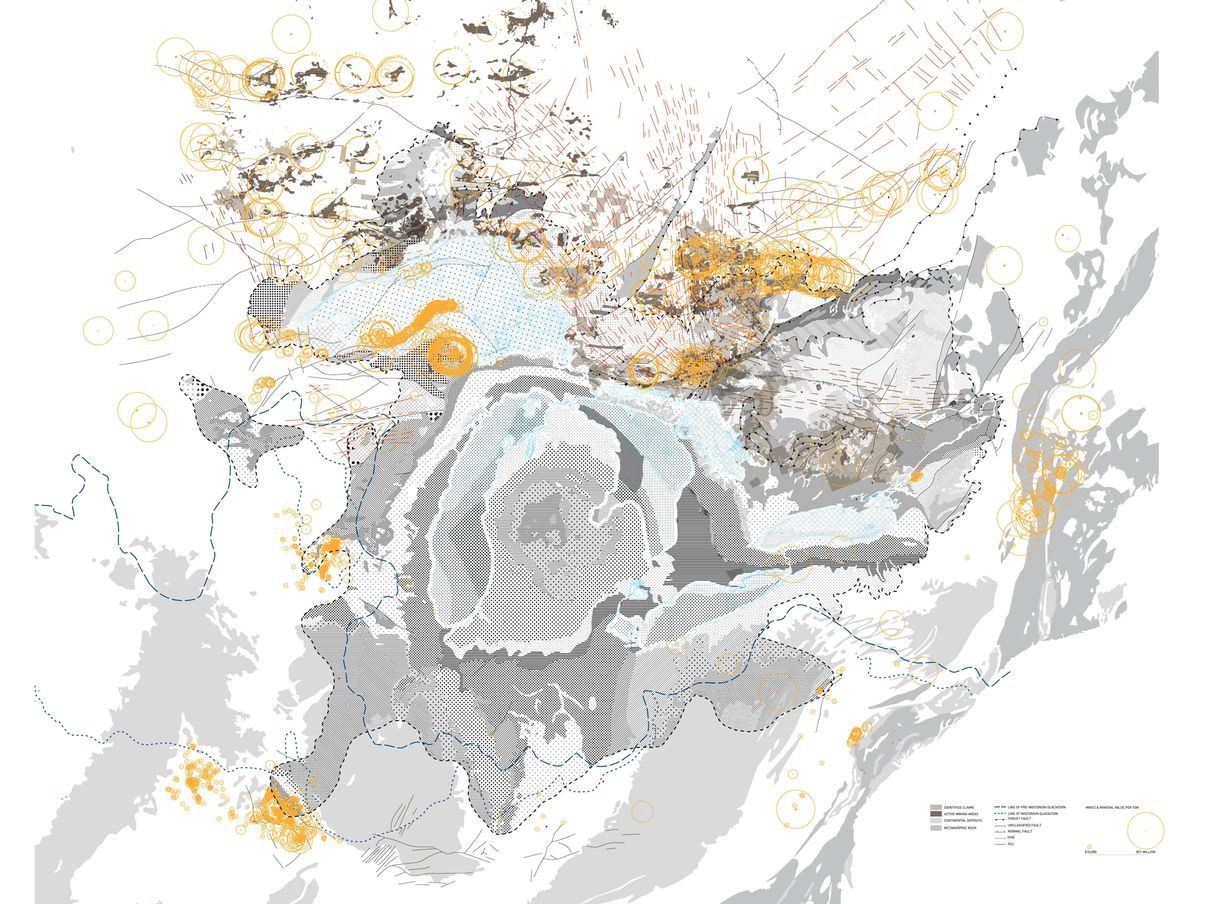
Conduit Urbanism is a multi-year body of design research that explores large-scale urban systems, networks and possible urban and architectural futures within the Great Lakes Megaregion of North America. Positioned within the lineage of speculative, visionary urban proposals, this work is situated within a critical analysis of networked agents, flows and ecologies. The design manifesto leverages the anticipated yield of renewable energy development towards alternate social ends and imagines the future of urban centers and peripheries through this lens. In this détournement, a new infrastructural network is knit within current systems, linking grid-tied high speed rail, environmental remediation and emerging industry sectors, while staging a series of urban-scaled architectural artifacts designed to organize flows and house new public megaregional institutions. The proposal begins with a restructuring of the highway’s constituent DNA from a simple, single-purpose and single-access surface to an intelligent network of bundled modes of mobility, energy and services. This viaduct is networked with other local and international systems of conveyance, transit and transport, forming an open and interconnected corridor that effectively collapses time-space within the region. Situated as a fragmentary urban utopia, infrastructure is appropriated for social and inclusive ends, bringing together diverse populations of individuals to constitute a megaregional public from which alternative political and architectural formations emerge. Along its length, sites of highway interchange become places where new large-scaled multipurpose developments are strategically implemented.
Research
2008–2013
Territories and Urban Systems
Overview
The interchange nodes become points of transfer, congregation, exchange and also house new public megaregional institutions. Networked with other urban systems, each interchange also makes itself distinct as an urban artifact, maintaining its architectural legibility and iconic position within the megaregion. Prototypical interchanges are developed typologically, and three major interchanges are explored at Chicago, Detroit-Windsor and Toronto through more detailed design proposals. Portions of the work have been published in "Volume," "MONU," "New Geographies Journal" and "Infrastructure as Architecture". The work has been funded through a 2009-2012 Canadian Social Sciences and Humanities Research Council (SSHRC) Research Creation grant.
This work also forms a significant part of our book Infra Eco Logi Urbanism: A Project for the Great Lakes Megaregion
Credits
Kathy Velikov, Geoffrey Thün and Colin Ripley. Team: Dan McTavish, Mary O’Malley, Adam Smith, Lisa Sauvé, Caileigh MacKellar, Zain AbuSeir, Richard Tursky, Matt Storus, Matt Peddie, Charles Gurrey, Maya Przybylski, Mike Vortruba, Ian Ting, David Weinreich, Sonja-Storey Fleming, Jeff Cheng
Scope and support
Scope: Research includes intensive regional analysis and mapping, agent-based mapping, energy and mobility design, historical investigation of related architectural and urban works, and urban/architectural design proposals at multiple scales.
AWARDS | GRANTS
ACSA 2013 Faculty Design Award | Honorable Mention
Van Allen Institute Life at the Speed of Rail Competition 2011 | Honorable Mention
exhibitions
Infra Eco Logi Urbanism. Taubman College Liberty Gallery | Ann Arbor, Jan - Feb 2015
Yale University Architecture Gallery, New Haven, Aug - Nov 2014
Paul H. Cocker Gallery, Ryerson University, Toronto, Feb - Apr 2014
Centre de Design, UQAM, Montreal, Feb - Apr 2013
Future City Lab: Future In Progress: Please Do Not Disturb, Architekturforum Aedes, Aedes Pfefferberg, Berlin, May - Jun 2012
Twenty + Change 02, Gladstone Gallery, Toronto, ON, Jun – Aug 2009
rvtr: matters of concern. Cambridge Galleries at Riverside, Cambridge, Oct 2008 - Jan 2009
RIG: Designs from the Fuel Transition, Toronto Free Gallery, Toronto ON, Nov 2008 - Jan 2009
Young Architects Forum 2008: RESONANCE. The Architectural League, New York, May - July 2008
Gallery